Upcoming Events

Saturday, January 10, 2009

You must DESTROY to rebuild.

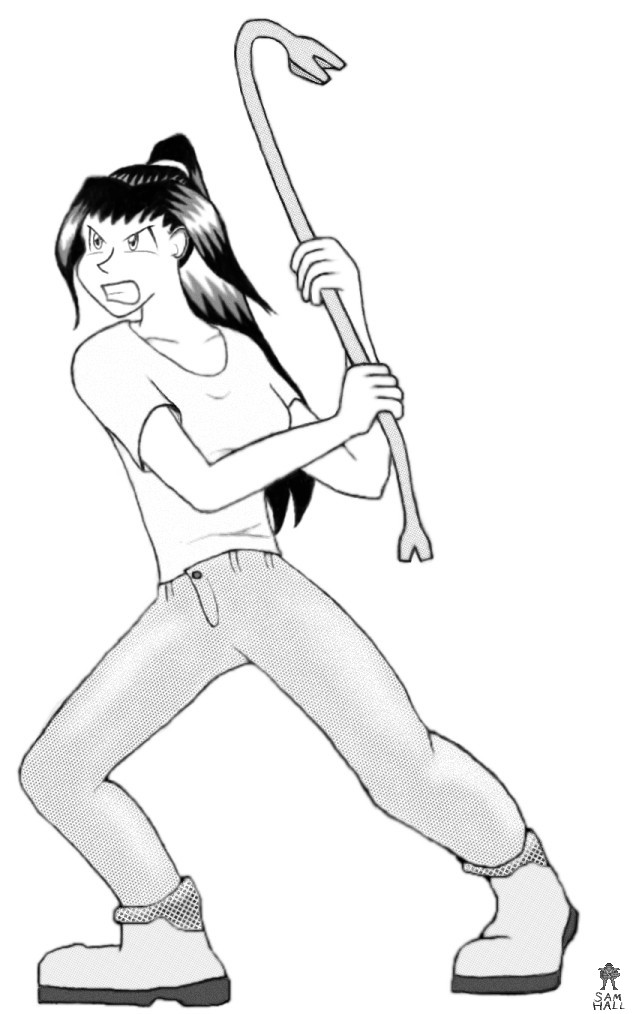
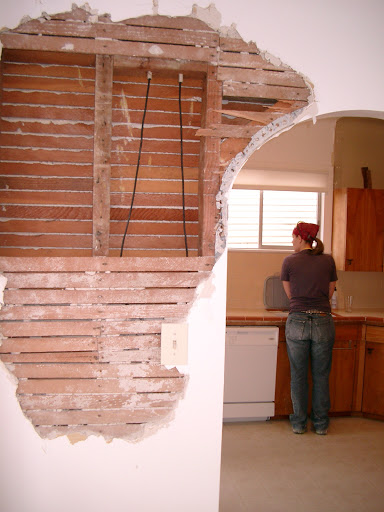
It's hard to tell whether the people who are volunteering with me are having fun or not. They say they like the work, but am I just torturing them? Are they waiting until a convenient time when they can duck out? I will say, though, there is one activity that is fun for everyone. Regardless if a person is young or old, silly or serious, I have yet to hear of a person who does not enjoy demolishing walls. One volunteer describes it as her "daily zen." The handling of a crowbar, hitting it with as much force as possible against the plaster walls relieves stress levels and erases worry lines. Perhaps instead of botox injections, the stereotypical trophy wife should look to this activity to keep the life in her aging face!

Step one to rehabbing a house is getting over the fact that you have to do more damage before things can be improved. It seems counterintuitive; doesn't destroying walls bring you farther away from the finished product? Actually, "demo" is a very needed process...it's the only way to truly know what's going on in your renovation project. Does it need to be insulated? Rewired? Are there leaks? Is there mold? All of this can be determined when taking down a wall.

Steps to correct and
safe "demo":
Equipment needed: mask, safety goggles, hardhat (a must if you're doing ceilings), heavy boots to avoid stepping on nails, crowbar/sledgehammer

1. Remove trim by delicately prying it away from the wall. Remove nails with a nail puller--pull them out from behind and you will prevent the finish from being ruined.
2. Remove wall fixtures. TURN OFF POWER. Unscrew the screws that hold them and disconnect the attached wires. Once the wires are disconnected, put electrical tape or wire nuts over the bare ends of the wire before turning the power back on.
2. Remove plaster. If your wall is covered with plaster and lath, first knock the plaster off with a small sledgehammer or the butt end of the crowbar. If you're not totally ripping out the wall and you keep the lath on, you can go over it with 1/4-3/8" drywall. Works just fine and saves the time it would take to rip out the lath.
4. Remove lath. If you do decide to rip out the lath, by removing the plaster and lath separately, debris will be much easier to handle. You now have a wall that's completely down to the bare bones. If you want to totally get rid of it, you need to determine if it's load bearing or not and proceed from there...more on this later...
5. Clean up. Probably the most important part of a renovation other than safety is keeping your workspace clean. Shovel the plaster pieces into heavy-duty contractor bags and tie the lath together to make piles. You can either throw this in the garbage, or keep your feet toasty warm and use it as kindling for your fire!

It's electric! (boogie woogie woogie)

Called up the power authorities that be and got my electricity turned on today. It was surprisingly easy, but I figure that's probably because they're expecting returns on investment...if they come and turn on the juice then they've just put another paying customer in their system. If you need the electricity turned on at your house all you have to do is:

1 Call the power supplier in your area, schedule a starting date so they can switch on your electricity (You do not have to be present when the guys come and turn it on)
2 Register where your bills are being sent to. If you're smart, the mailing address is to Barbados. Just kidding--paying bills is an important if annoying part of home ownership, so make sure your address is correct so you can pay bills on time!
3 Before your system is put back online, MAKE SURE YOUR MAIN BREAKER IS SWITCHED OFF. This is the single most responsible, smart thing you can do in this situation, especially in older houses with shady wiring. You don't know where there are hidden cords and what connects to where, so better safe than having your house burn to the ground.
4 Test each and every outlet and light fixture. To do this, you must first locate which switches go to what portion of the house. Flip switches one at a time to on in the breaker panel, bring a partner to tell you what works and what doesn't. A good tool to use is a plug-in nightlight. You probably have one lying around, one of a seashell when you went on a trip to Cape Cod, or something perhaps a bit more embarassing. They're an easy, quick way to see if an outlet is working. Just plug in and you have your answer! Be sure to mark all fixtures and outlets that are not working so that you can return to them later to find out the problem...

Wednesday, January 7, 2009

Prioritizing

1. Getting to know my house. We're going to be best friends for the next nine months that I am working full time on this project, so I'd better know it's likes/dislikes, wants/desires. The only way to understand a house is to walk in it and to be what my mother calls a "hungry noticer." Like that game Hungry Hungry Hippos, only not eating plastic white balls. Luckily I inherited the "hungry noticer" genes from her and so took it upon myself to document every part of the house. Problems, things I like, things I want to change, things that I want to like but most likely will change. I took a pencil, measuring tape, and a piece of paper.

First things to go...
Hideous 70s paneling
Ripped linoleum
Pumpkin orange wallpaper
Cracked Toilet

But these are minor changes. In the long run my vision is to open up the side entryway by ripping out a non load bearing wall and expanding the kitchen. This will make for a more communal space. Who doesn't want to gather in the kitchen?? It's where all the food is!

2. Finding Structural Problems. Ok, so this really should be first, but it's a scary subject so I
like to think that it can be second. Nothing should really be done with the interior before any structural adjustments are made. This includes reframing/restructuring/resupporting, jacking the house if it's sinking, reroofing...basically anything that could allow for water damage or for the house to ultimately collapse. Yeah, pretty important.

The structure of the house is remarkably sound. As my friend Kevin says, "these old houses are built with so many little pieces that it is very difficult to completely collapse the structure." Even if people cut support beams. My problem here lies in the back addition...the addition is attached to the front of the house with rafters. Unfortunately, the addition is sinking, pulling on the front of the house, making the house all out of whack. The first attempt to fix this will be to jack up the back of the house and see if I can realign the structure.

So I have a few leaks evident in my house, but it's difficult to tell whether they're new or if they've been patched up. My guess is that someone attempted to patch up holes but did a pretty shoddy job. Call me crazy, but duct tape isn't going to be useful in this. It solves almost everything, but it doesn't solve the fact that I can see to the outside in places. Unfortunately I can't really do much until spring because I need to get onto the roof and check out the flashing, especially around the chimney (looks like swiss cheese it has so many holes!). I don't really want to be walking on an ice-laden roof...

Major Updates: I'm getting the electricity on tomorrow, so we'll see what works. Some rewiring will be necessary for sure, but it'd be nice to have a space heater to take out the chill. It's 25 degrees here and I'm freezing my little piggies off!

Tuesday, January 6, 2009

Yes, InDEED!

It's been a long time coming, but I finally have my deed! Silly, because I bought the house in October and am just getting license to enter...right in time for the coldest weather to hit. Imagine if I were moving into the house today--there is no way I could get the heat going on day one, even with a perfectly intact and up to date system! So I would have to suffer through a few nights of deathly cold! And that's assuming I didn't need to replace any radiators, boilers, etc. (which I probably will have to do). Perhaps the city needs to consider changing the time of the foreclosure auction to spring so that people have ample time to get their homes back online before the Buffalo winter hits?

Anyway, I took an initial look around and found...a MESS. The previous owners/renters left all their junk on the second floor, complete with year and a half old birthday cake! And the fridge? ...ew. I opened it to inspect and a round of gagging ensued. I spent an entire day just cleaning all the garbage out so now I can actually start the huge task of rehabbing.

BUT--luckily my house is in remarkably great shape! There isn't major major structural damage, I'm only missing about 6ft. of piping, and it looks as though I have nice wood floors that just need a little TLC. I even have a wonderful set of pocket doors and a newly refinished bathroom! All in all, the house has 6 small bedrooms, two floors, two bathrooms, an attic, a basement, two kitchens, a porch to sit on, and a big backyard for my garden! Can't wait to start getting my hands dirty, learning the basics of housing rehab...

Sunday, December 28, 2008

Billed for...nothing.

I got hit with a water bill a few weeks back--$90 per quarter, sewer maintenance fee. The bill, printed on official letterhead containing the seal of the City of Buffalo, read:

Dear MEGAN G MCNALLY:

According to the City of Buffalo Tax Department the above listed property was purchased at the October 2008 foreclosure sale.

The flat or metered rate account balance owed prior to the October 2008 sale, has been removed and the mailing information has been updated.

For metered accounts a final meter reading may be needed in order to properly adjust the bill.

Please call Customer Service if there are any questions regarding this account.

The actual water bill was on another sheet of paper. Included was a confusing list of what seemed like 20 different rates, the amount of water usage (which for me was zero), and an estimated water bill. My question was...did I actually have to pay it? The people at the foreclosure sale told me that from day one I'd be liable for anything to do with my house, but it was December 22nd and I had yet to receive any deed stating I was the rightful owner to any property. And how can you be hit with bills if you can't actually claim ownership?

I assumed that there was no way to avoid this fee and that I'd just have to pay it, but I figured I'd call the water authority just to make sure. Well, the woman who answered the phone wasn't positive about the fee, but told me that I would most likely be required to pay it because the city had already reduced my bill since the foreclosure sale (the previous owner owed ~$1500). I politely asked if she could check with someone who could provide a more definitive answer. She put me on hold for about 5 minutes, talking to a superior of some sort. Upon returning, she was flustered and said something to the effect of:

"Oh well, we wouldn't normally do this but....I mean, since you don't officially have the deed yet...well, my manager says we aren't technically allowed to charge you so...your fee will be waived until the next quarter."

It was like they were doing me a huge favor by waiving the fee, when really shouldn't they not have charged me in the first place?? This is one instance where it seems like the water authority gets away with charging people incorrectly. It really makes me irritated because I know that probably
95% of the population would assume that the water authority knows what they're doing, it's a quarterly charge, there's no getting around it, and they would end up giving them the $90! And in my neighborhood, who can afford to dish out $90 for a bill that isn't even legitimate??

It's totally not fair because I can guarantee that most people
a) would have paid unnecessarily
b) would not think/know to call and question the bill
c) would have had to pay regardless because the workers probably decided on a whim to waive the fee, based on my politeness and the fact that it was the holiday season!

I guess I'm slowly but surely learning about home ownership...but if I can't figure this stuff out and am encountering problems, wouldn't you say that there is something fundamentally wrong with the system? At least in my neighborhood it sets a person up for paying fees which they can't afford to pay, causing them to have liens on their property, leading to foreclosures and ever increasing urban blight. Now, that may seem a little overdramatic when just talking water bills, but add up all the fees, utilities costs, taxes, etc etc and you can see how this can negatively impact a neighborhood!


Monday, December 1, 2008

Community is about taking care of one another.

I suppose you've all heard the news of the person getting trampled in the Black Friday rush last week; consumerism triumphed over the would-be helpers in the situation, forcing them away from the poor fellow being crushed by the stampede of post Thanksgiving shoppers. I read this in the newspaper and was sickened. Isn't the holiday about being thankful for what we have and about helping others? How can we ever build a united community if we are trampling over one another, just anxious to get ahead? Just anxious to buy that silly toy or one more pair of pants? After reading the horrifying news in the paper I thought I needed to share an update. One which involves taking care of community members and the joy that results in giving just for giving sake...minus all the consumerism bs.

I visited my house the other day; I checked up on it and added a little christmas cheer (there is now a huge snowman smiling in the window!). I was just about to leave when a guy in his late twenties came up to me. He had heard that I was doing a housing rehab project and wondered if he could help me out for a little extra cash now and then. Well, I think that when you're part of a community, you gotta support each other. So after talking for a minute, we decided he would shovel the sidewalks when it snowed and check on the house while I am away at school in return for some money. This a) gets rid of my worries surrounding upkeep of the house and b) helps my neighbor out, so it is mutually beneficial. This is EXACTLY what we as a society need to be doing more of! Helping neighbors out, talking to each other, developing relationships, etc.

Where I used to live no one spoke to each other...you got home and entered your house, never saying hello to people in the surrounding houses. I felt a real disconnect--it took a move to a more social neighborhood to realize what great relationships communities have to offer! We should go against this habit of non-communication and reach out to our neighbors, get to know the friendly and interesting people living around us! We all have stories to tell and each of us has value within our society. This house and this project was started because I see a need for myself and others in the community to come together and just talk to each other, so hopefully getting my path shoveled by a neighbor is only the beginning...

The second part of my update is about giving. There's that old folk tale about the little red hen. Little Red Hen does all the work around the house and makes some bread. She works for hours and hours with no one helping her, and even though no one helped her get all the ingredients or do all the baking, Little Red Hen still shares the bread with everyone in the end. It's like giving a cup of sugar to your neighbor--not because you expect repayment, not because you can then hold something over their head, but just because. The same lucky day I found help with shoveling the sidewalks, I also got the chance to give a gift...just because.

Oddly enough, I had a poinsettia in my car. Now, I don't just go around carrying poinsettias, but for some reason I had one. I had just finished making arrangements for shoveling my sidewalk when the woman from across the street walked over. I had met her before and we had become good friends over the summer. She was always outside cheering me up when I was sweaty and grumpy after a day working in the community gardens down the street. While telling her about my rehab project and what I planned on doing with the house, I suddenly thought of the poinsettia in my car. What does a college kid need with a poinsettia? I'd probably forget to water it... Anyway, I gave the poinsettia to my neighbor, just because. She was so surprised and happy, and then I realized, you know what? It isn't about the giving...it's about not expecting something in return and giving just because you're neighbors. It's about making friends with the people around you and supporting one another. With both neighbors that day I learned it's about making ties--making relationships so that when you need help, people will be there for you. It may not be enough to rebuild a community yet, but like I said before, it's definitely a start.

Giving thanks...thanks for giving!

It's a little past Thanksgiving, but I just wanted to extend a heartfelt thanks to all who have contributed to the project thus far. Thanks for making this possible. Of course, you are all invited to stop by the house to attend a workshop or potluck and receive a grand tour! Without your contributions I would still be at school next semester, not pursuing something I care so deeply about. So this Thanksgiving I am thankful for all the wonderfully supportive people who have contributed money, time, advice and their superb ideas...you've really made a difference.